The Challenge
Survey creation and management at a large professional services firm was painfully slow. Project leads and CSTs needed to depend on a dedicated development team for even basic survey tasks — creating, distributing, managing respondents, and downloading data. This created bottlenecks, delays, and a lack of transparency at every stage.
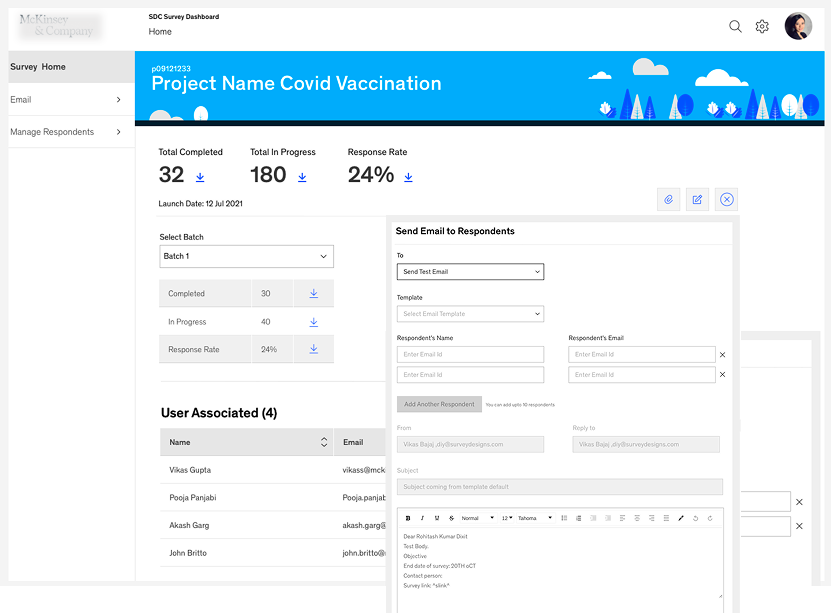
The goal was a single, self-serve dashboard that enabled firm users to manage all survey-related activities independently. The new platform needed to streamline post-launch activities such as sending emails, downloading data, and managing respondent lists — and significantly reduce the need for direct interactions with the SDS team.
Product Design Lead
I led the end-to-end product design for SSDA. Working closely with project managers and subject matter experts, I identified actual pain points in the existing process and translated insights into design concepts and solutions. I also facilitated key strategic discussions and workshops with multiple stakeholders to build the vision of digitising the entire survey development process.
Throughout the build, I followed an agile process — collaborating with the product owner on sprint refinements, supporting the technical team in developing prototypes, and resolving design constraints in real-time. During the Beta phase, I conducted multiple user sessions to identify usability gaps and iteratively improved the experience across releases.
Fragmentation vs. Unification
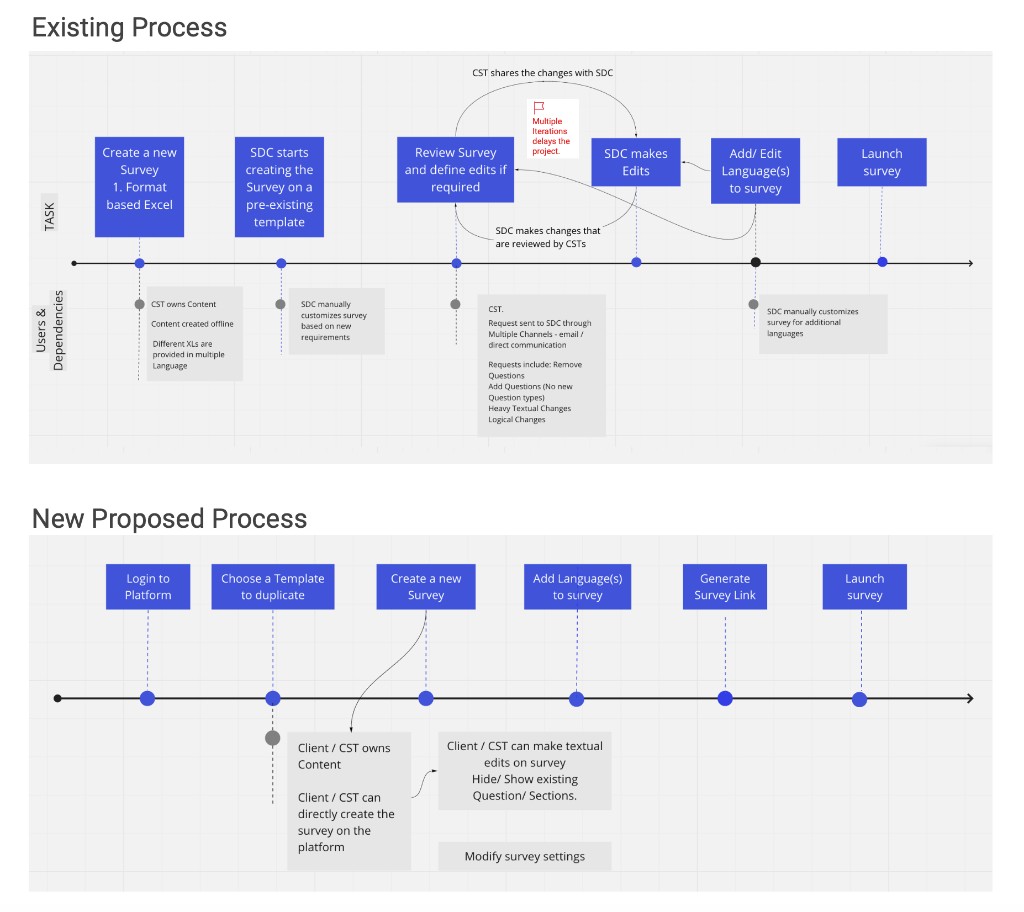
Existing Process
- Multiple disconnected tools for different survey tasks
- Heavy reliance on the dev/SDS team for all actions
- Offline documents and spreadsheets for tracking
- No single source of truth for survey status
- Manual emails and respondent list management
- Long iteration cycles, delays on basic changes
- Zero integration between survey and distribution tools
The SSDA Solution
- Single, unified self-serve dashboard for all tasks
- Independent survey creation and management
- Automated email sending and respondent tracking
- Transparent real-time visibility into survey status
- Seamless ConfirmIT integration for data flow
- Efficient user access management
- Removal of legacy SDC Dashboard and distribution tool
Building the Vision, Then the Product
The project began with building a shared product vision — a digitisation pitch grounded in real user pain and stakeholder alignment. From there, the design process followed an agile rhythm with continuous user feedback shaping each release.
Vision & Digitisation Pitch
Partnered with PMs and SMEs to identify pain points and translated insights into a compelling vision for fully digitising survey development.
Stakeholder Workshops
Facilitated strategic discussions with multiple stakeholders — CSTs, project leads, and the SDS team — to align on scope and goals.
User Research & Journeys
Conducted user sessions to understand mental models and crafted detailed user journeys that informed the platform's architecture.
Agile Design & Prototyping
Followed agile process to design and develop features in sprints. Collaborated with PO on refinements and supported the tech team in developing prototypes.
Beta Testing
Led multiple user sessions during Beta to identify usability gaps and observe user behavior patterns, feeding directly into improvements.
Iterative Releases
Improved the experience across incremental releases based on real usage patterns — continuously raising the bar on usability and efficiency.
Designing for Independence
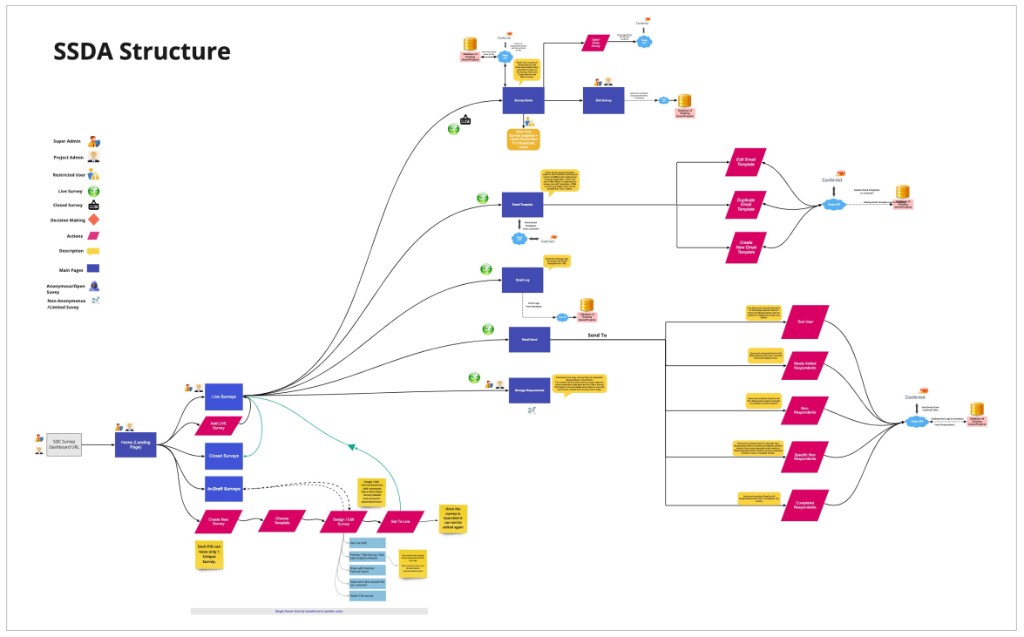
Every design decision was oriented around one goal: giving users the confidence and capability to manage surveys without needing a developer. This required rethinking the information architecture from the ground up — not just digitising the old process, but redesigning it.
Single-platform architecture — all tasks (creation, distribution, data download, respondent management) consolidated into one coherent dashboard, eliminating tool-switching.
Mental model alignment — user journeys were built directly from how project leads think about survey work, not from how the system was technically structured.
ConfirmIT integration — seamless system integration removed the manual handoff between survey creation and data collection, enabling a true end-to-end workflow.
Phased agile delivery — releasing in increments allowed the team to validate design decisions with real users early and continuously improve before a full rollout.
From Bottleneck to Empowerment
SSDA transformed the survey process from a developer-gated workflow into a user-owned, self-serve experience — with measurable gains in speed, autonomy, and transparency.
90% reduction in dependency on the development team for survey management — freeing significant capacity across both tech and project teams.
Single platform replaced multiple disconnected tools including the legacy SDC Dashboard and SDC distribution tool, drastically reducing process fragmentation.
Full transparency brought to the survey process — every stakeholder could now see the status of any survey at any point, eliminating ambiguity.
User capacity freed up — project leads no longer needed to manage survey-related touchpoints manually, enabling them to focus on higher-value work.