The Challenge
At a global management consulting firm, pricing decisions were being made in isolation — relying on fragmented data sources, personal experience, and informal peer consultation. This created significant variability across similar engagement types and left partners without the structured intelligence needed to price with confidence.
The result: inconsistent pricing, limited transparency into historical price realisation, missed opportunities to course-correct toward healthy economic thresholds, and a heavy manual burden on partners trying to identify relevant comparables for new engagements.
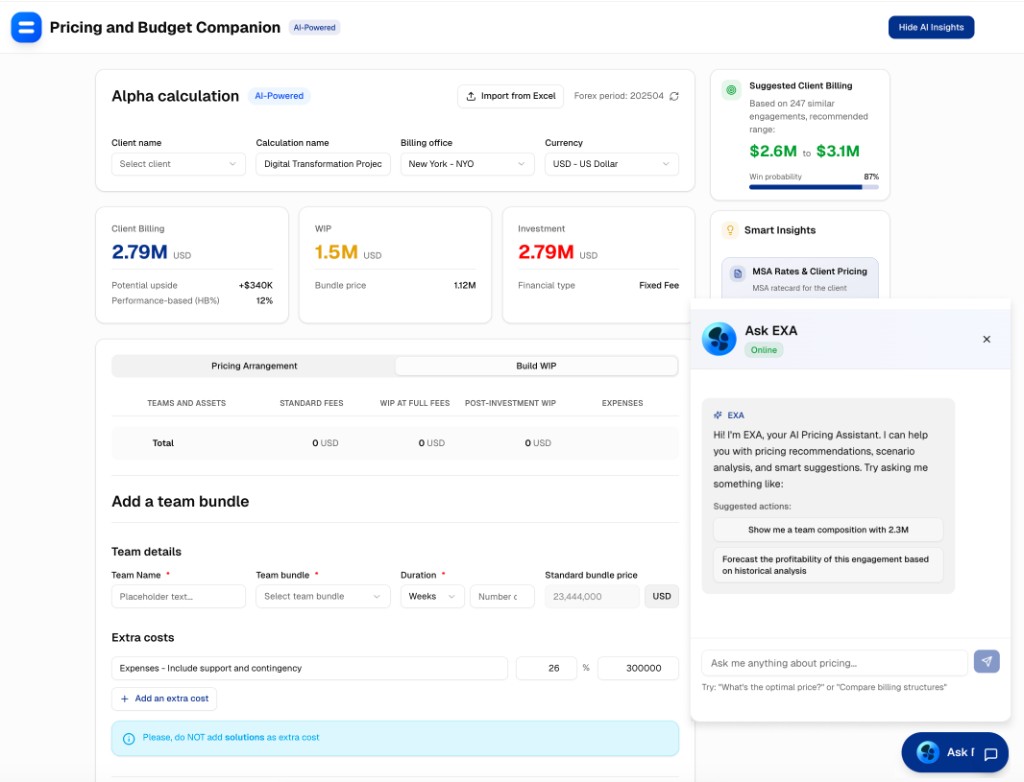
Bringing Pricing Discipline to Partners
"To bring pricing discipline among partners to ensure healthy pricing that supports firm economics."
Pricing Intelligence was conceived as an additional intelligence layer within the existing Pricing and Budgeting tool — embedding structured, AI-driven insights directly into the tools partners already use, at precisely the moments they make pricing decisions.
The goal was not to replace partner judgement, but to strengthen it — surfacing the right benchmark data, historical intelligence, and health markers at the right level of specificity, so every pricing decision is grounded in evidence rather than instinct.
Before & After
The Old Reality
- Pricing decisions driven by fragmented data and informal consultation
- High variability in pricing across similar engagement types
- Limited visibility into historical price realization and CI usage
- Manual effort to identify relevant comparable engagements
- Missed opportunities to pre-emptively adjust toward healthy thresholds
- No structured governance signals embedded in the pricing workflow
The Intelligence Layer
- AI-driven insights surfaced directly within PBC at key decision points
- Benchmark perspectives at the right level of specificity (e.g. archetype)
- Historical engagement and client intelligence at point of pricing
- Aggregated CI history surfaced contextually when CI is selected
- Health markers signalling pricing consistency and realization risk
- Governance transparency — thresholds and committee signals embedded in flow
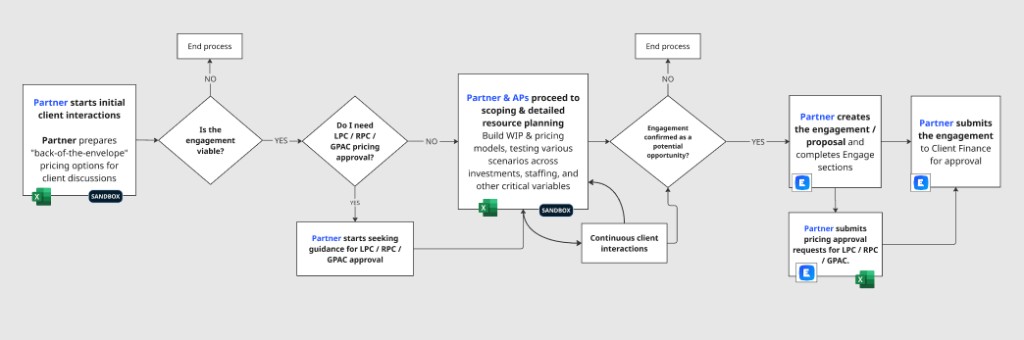
Leading Design from Strategy to Interface
I led the UX strategy and end-to-end design for the Pricing Intelligence initiative — translating complex functional requirements from the FSD into a clear, intuitive experience that could be layered into an existing partner-facing tool without disrupting established workflows.
Working closely with product owners, engineers, and finance stakeholders, I was responsible for defining how AI-generated insights would be surfaced contextually — ensuring they added value at precisely the right moments without overwhelming or distorting the core pricing flow.
How We Got There
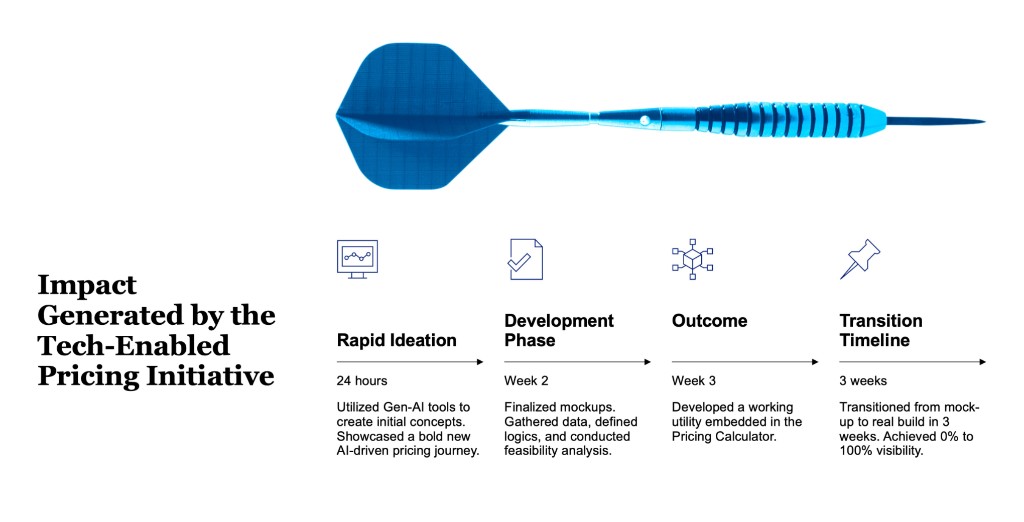
The initiative moved from bold concept to working product in just 3 weeks — powered by Gen-AI tools, rapid prototyping, and tight cross-functional collaboration. Each phase was deliberately time-boxed to maintain momentum and deliver real utility fast.
Rapid Ideation
Utilised Gen-AI tools to create initial concepts. Showcased a bold new AI-driven pricing journey to stakeholders within 24 hours.
Development Phase
Finalised mockups. Gathered data, defined logic flows, and conducted feasibility analysis with engineering and finance stakeholders.
Outcome
Developed a working utility embedded directly in the Pricing Calculator — moving from concept to live product in a single sprint.
Transition Timeline
Transitioned from mock-up to real build in 3 weeks. Achieved 0% to 100% visibility — from nothing to full partner-facing deployment.
Designing Intelligence That Earns Trust
The core design challenge was not just surfacing data — it was making AI-generated insights feel credible, relevant, and actionable without creating noise or eroding partner confidence in their own judgement.
Insights, not instructions — the intelligence engine was deliberately designed to surface benchmark perspectives and considerations, never to recommend specific actions. This preserved partner autonomy while improving decision quality.
Contextual pop-up intelligence — insights appear as non-blocking pop-up windows triggered by specific partner inputs (e.g. client name, pricing arrangement, engagement type), ensuring relevance without clutter.
Smart pricing health markers — visual health indicators designed to communicate pricing consistency, realization risk, and governance alignment at a glance, enabling partners to self-assess before submission.
CI history at point of decision — when a CI-inclusive pricing arrangement is selected, aggregated and sanitised client investment history surfaces automatically, enabling more purposeful and transparent CI allocation.
Archetype-level specificity — insights are calibrated to the right level of granularity — broad enough to be statistically meaningful, specific enough to feel directly relevant to the partner's engagement context.
Results That Speak
The Pricing Intelligence initiative was designed with clear, measurable OKRs tied to firm economics. The design directly supports the following targets across the pricing journey.
85% adoption rate targeted by year-end 2026 — up from 0% baseline — driven by embedding intelligence seamlessly within the existing partner workflow rather than introducing a new tool.
92% price realization targeted by year-end 2026, improving from current baseline by strengthening partner confidence in healthy engagement structuring from the outset.
CI allocation reduced to 9% by mid-2027 — from 11% baseline — through more purposeful and evidence-based CI decision-making enabled by contextual intelligence at the moment of pricing.
Improved pricing consistency and governance transparency — pricing committee thresholds and health signals embedded directly in the partner workflow, reducing variability across similar engagement types.